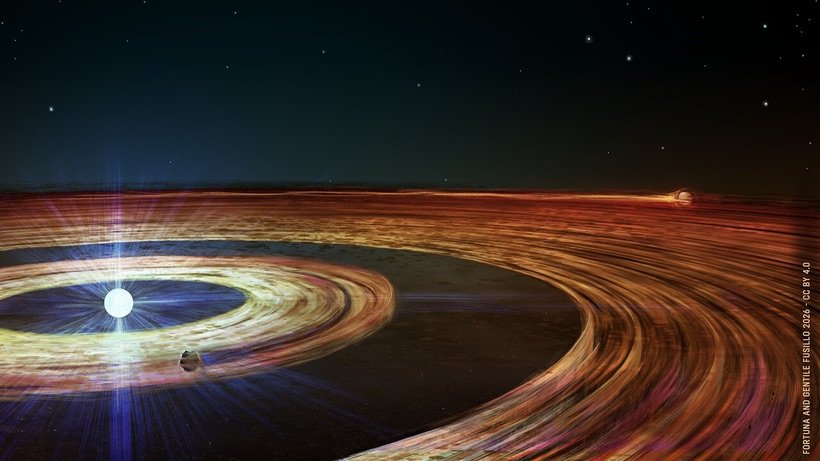
An artist's concept of the white dwarf J1328−1450 system. Image: Fortuna and Gentile Fusillo
When I was a little kid, my grandmother would buy my older cousin subscriptions to science magazines, and then when he was done with them, they would pass along to me. My favorite was Odyssey magazine, which was all about space and other science of that nature. I was obsessed and would read every issue cover to cover again and again. In particular, I kind of loved the scary stories about lightning and fireballs appearing in mysterious places. But I also loved imaging the end of the solar system. Yes, your girl was kind of a dark kid. The article said that when the sun became a red giant, it would swallow the inner planets up to Mars. I used to fantasize about what would happen, and then I realized there was no way we could escape, and...well. the fact that it wouldn't happen for another 4-5 billion years didn't stop me from imagining apocalyptic endings for humankind.
But what will happen to the solar system when the sun dies? I mean, beyond human involvement, because let's face it, we will have evolved into something else by then, or else obliterated ourselves. Well, scientists at European Southern Observatory's Very Large Telescope have gotten a glimpse at one possibility.
After a star like our sun becomes a red giant, it will eventually collapse in on itself and become a white dwarf. White dwarves are very dense but dim stars, having burned up their fuel and let loose some of their outer material to space around them in a planetary nebula. We've discovered many, many planetary nebulae, like the Ring Nebula, the Helix Nebula, the Cat's Eye, and my personal favorite, the Owl Nebula. They are colorful dusty clouds in space that last for hundreds of thousands of years before they dissipate. But what about the planets that used to be in the system? Some of them might have been vaporized during the star's red giant phase, but what about the planets farther from the star?
Recently, scientists found a white dwarf star with a disc of gassy debris around it--remnants from the planets that were once there that broke apart and were partially vaporized. We've seen this before around other white dwarf stars. But this disc has two gaps in it, making it look like a double disc. Scientists believe that this gap in the disc was created by the gravitational pulls of two planetesimals, remainders of what used to be two planets that orbited the star. One of these is estimated to be the size of an asteroid, a few miles across. The other one, further from the star, is larger and could be the size of Pluto or our Moon.
Not only did they find the double disk, but scientists also found that the two disks have different compositions, with the inner one rich in magnesium and the outer one lacking it. This suggests that the debris in the rings could from two different planets with different compositions, much like the planets in our own solar system. On the other hand, the debris could be two parts of the same planet, like the crust and the core, which in the case of Earth are made of very different materials.
Scientists made this discovery using the X-Shooter instrument on the Very Large Telescope in the Atacama Desert in Chile. This is a three-armed spectrograph that collects light and can image it in three ranges of wavelengths: one for short wavelength ultraviolet light, one for visible light, and the third for longer-wavelength near infrared light. The scientists looking at this white dwarf star saw a spectrograph pattern much like from other stars that had a disc of debris around them, but rather than two peaks in the spectrograph like the single disks had, this one had four peaks, suggesting two discs. The peaks come from the different wavelengths of light caused by material coming toward us (blue-shifted, shorter wavelength light) and material going away from us (red-shifted, longer wavelength light). In a single disc, we'd see two measured peaks, one "blue" and one "red" from the material orbiting the star. With two discs, we see two blue-shifted peaks and two red-shifted peaks, because two distinct bands have a darker gap between them. The graph tells us a little about the structure of the discs. The two middle peaks are one disc and the two outer peaks are from the second disc.
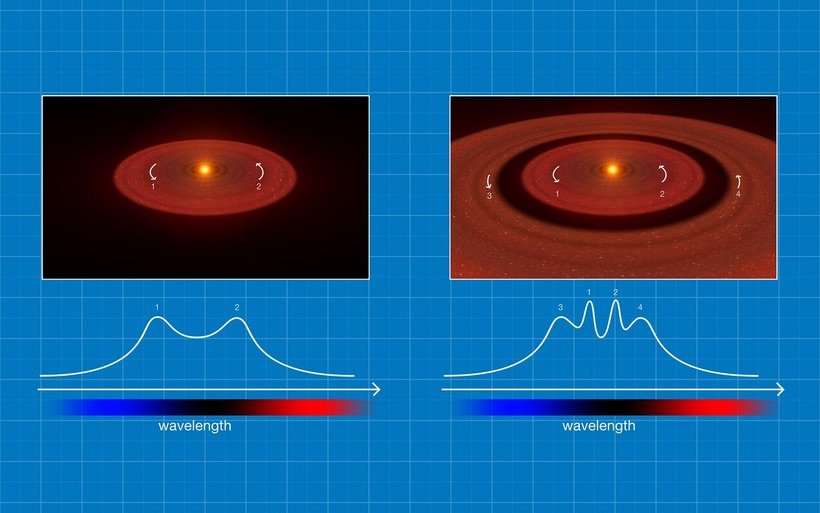
Image: ESO
The planetesimals contained in the disks can't be directly detected, but scientists were able to infer their potential masses by the speed the discs traveled around the star as well as the distances of the discs from the star.
The Very Large Telescope is able to use its sensitive instruments to detect things like this because it is on a high peak in the dark Atacama Desert in Chile, one of the darkest places left on Earth. Observatories in other locations on Earth wouldn't have been able to detect this light because of the amount of light pollution in the night sky. This is why being conscious of how much light we are using, where that light is pointing, and the purpose of the lighting is really important.
This research could lead to an understanding of what might happen to our own planet and solar system some day in the far future.

Melanie R. Meadors is a freelance science communicator, the associate editor for the Biographers International Organization, and the president of the Aldrich Astronomical Society. She lives with her family in central Massachusetts.